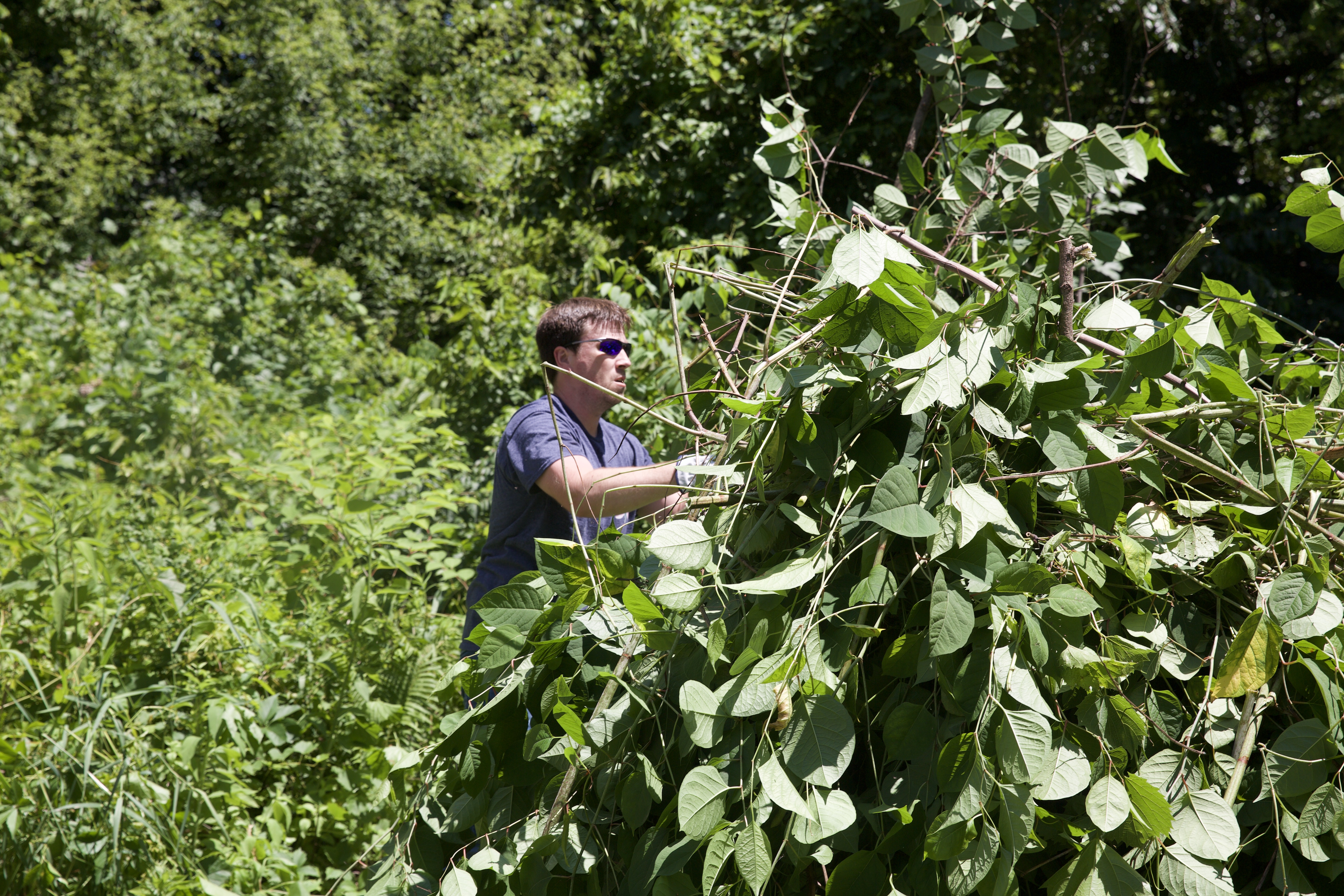

You couldn’t even tell there was a small hill behind the Sugar House. It was hidden by a thick wall of Japanese knotweed reaching nearly nine feet tall. This highly invasive plant grows quickly (up to two feet per week) and can smother native plants. Stopping these invasive plants in their tracks is a daunting task necessary to maintain the health and biodiversity of the land around our original barn headquarters.
On a sunny Friday afternoon in June, a dozen volunteers from the IFF Cedar Rapids plant put on work gloves, grabbed tools and walked into the wall of Japanese knotweed, which stood taller than they were. They were ready for the challenge!
“Nick (ICNC’s Trail Coordinator) asked us to come out and help remove the Japanese knotweed. He said it’s very prolific. It takes a lot of effort over time to get it knocked down. He’s having us cut it down the best we can and then make a compost section for the clippings,” said Sarah Fersdahl, Environmental Engineer.
After a few hours of hard work, the volunteers had cut down the wall of Japanese knotweed, and now the object that towered over them was the compost pile where volunteers stacked the weeds they removed.
Battling invasive species has been a major part of the Nature Center’s land management strategy since the derecho in August 2020. The Nature Center is grateful for local companies, like IFF, that support their employees’ desires to volunteer and make a difference.
“The leadership team gives us four hours of paid time that we can use to volunteer per year. They totally support us going out [to volunteer],” says Fersdahl. “I think [volunteering outside] is probably our favorite. We do outside volunteer work twice a year, and one activity inside the plant. We’ve done things like packaging diapers for the Young Parents Network and hygiene kits for HACAP. Doing it at the facility so people can help over their break makes it easier for people to participate.”
Volunteering is built into the calendar at IFF. “We did a site clean-up on our own property. Went around the perimeter of the plant to pick up garbage. We’ve done that for four years now,” says Greg Billick, Fermentation Technical Specialist. “It’s good to get out and do good.”
Every volunteer who came out that Friday was a member of the plant’s Green Team, which leads sustainability initiatives within the facility. They even conduct annual challenges to build personal sustainability habits within the plant staff.
“We distributed reusable grocery bags to cut down on the disposable paper or plastic bags. We tracked that 603 plastic bags were avoided in just two months,” explains Billick. “What we found is that a lot of people were already doing it. It was a good reminder for people who had them but would leave them in their trunk to actually pull them out.”
Thanks to the Green Team and support from the corporate office, IFF can make sustainability part of its decision-making process. “They [corporate] have a capital fund specific for projects that save electricity or steam that each facility can apply for and get money to go towards those projects. So, even if a project doesn’t have the typical return on investment, they have money set aside to fund sustainability projects,” explains Fersdahl.
Sustainability is being considered during the planning of an upcoming plant expansion that will bring production of a key fruit snack ingredient to Cedar Rapids. Fersdahl says, “It makes more sense to have a facility in the United States to cut down on shipping and transportation. That’s the sustainability aspect of it. We’re doing our best to design with that in mind.”
IFF is also supporting sustainability and land restoration as the lead sponsor of Trailside Tastings — an outdoor craft beverage festival that celebrates nature’s beauty and the art of crafting delicious beers, wines, ciders, and more.
The proceeds from Trailside Tastings, held amidst the Nature Center’s prairies on August 28th, will also go to supporting land restoration projects — like removing those pesky invasive plants from the hillside behind the Sugar House.
The Japanese knotweed was certainly set back thanks to the volunteers from IFF, but Trail Coordinator Nick McGrath knows the work isn’t done yet. “We’ll come back in a few weeks to cut back what’s grown back up. It’ll be a long, slow process, but worth it in the end,” says McGrath.
“[Nick] wants to plant service berries, which is a smaller tree that has berries for birds, and they’re actually edible for people too,” says Fersdahl, “They will go nicely with the black raspberries over there.”
Replacing towering invasive plants with edible, native berries sounds like a worthy challenge to us!