

Written by Assistant Preschool Teacher Karyln Senica
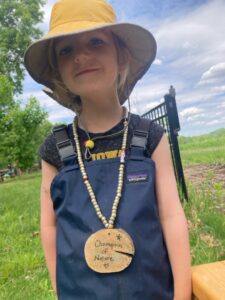
“I think it means…” her voice trailed off just for a moment to fully take in the question before finishing, “… it means to take care of nature. And to just let nature be.”
I turned to another student, also graduating from Creekside Forest School (CFS) this year, and asked him the exact same question.
“What does it mean to you to be a Champion of Nature?”
He set down the nature medallion he was beading for our upcoming graduation circle and looked up at me. “It means helping nature,” he said almost as if asking himself a question. Then a pause. “It means helping nature,” he stated again, this time with conviction.
I quickly glanced at Lead Preschool Teacher, Nicole Upchurch, and we had a mutual acknowledgement of how profound it was to hear a 5-year-old put into language what it meant to be a Champion of Nature.
This is not something we regularly discuss at our school, although it is embedded within the mission of both the school and the Nature Center itself. In fact, in every single interview at Indian Creek Nature Center, this very question is asked: “What does it mean to you to be a Champion of Nature?”
Yet, we are adults, with many years of experience and language to conceptualize this idea of championing nature. These are children — some of them in their first year of attendance at CFS.
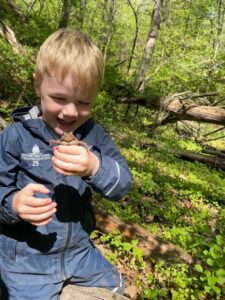
The idea that our actions and who we are as people have an impact on nature really is profound. And here stand two 5-year-olds already understanding it before they even start kindergarten.
They aren’t the only ones, either. At the start of the year, the idea of a spider being an animal that has its own life, and even deserves to live, was a questionable one for quite a few of the students.
Now, seeing a spider crawl across the limestone bleachers at the amphitheater is a much different experience. Of course, we still get the classic and inevitable “I HATE SPIDERS!” Then faces begin to creep in towards it. Observing it and dissecting it with their eyes. Questioning if it is, in fact, a spider, or something else. A consensus forms. It is, indeed, a spider. Then something unusual happens and voices echo: “This is its home.” “What is it doing?” “I’ve seen a spider outside at my house!”
They are voices of recognition that this creature is a living, breathing thing worthy of living its life.
This is at the heart of what we aspire to create at CFS. A sense of belonging and the impact we have on a group, on a space, and on nature. If you can for a moment, take in the absolute beauty of this. To see a young child accepting that something completely different deserves respect and kindness, and even a sense of curiosity about the differences we hold. This is the foundational work of raising kind, attuned humans.
The teachers don’t do this work alone. Time and time again, we rely on our co-teacher, nature.
Nature is responsive, abundant, resilient, and generous. Nature grows, changes, falls, and rises before us. This is the most active learning classroom imaginable. Nature invites even the most reserved child with its sounds, textures, sensory experiences, and creatures. Among all this, nature holds endless lessons within it.
I am reminded of the times we happened upon fur in Bena Brook and Bena Prairie. Immediately, the children became detectives, guessing what animal the fur could have come from, and eagerly following the trail of fur, which quickly became bones. Ultimately, this leads to large skeletons of deer. All reactions are welcome, and there were many. Gasps. Wide eyes. Tiny pointing fingers. “This is sad,” one student shares. This commentary sparks a discussion on the validity of feeling sadness in the presence of death. This animal has now become food and a life force for other species or life forms. We live in a culture that struggles to speak of death and even how to orient towards it. Nature hides nothing. It invites exploration around big ideas that can be familiar but perhaps difficult to understand and explain.
Nature makes space for all, and everything is invited.

Sitting at the edge of the forest as I contemplated what to share in this article, this slow drip of realization streamed down into my awareness. Nature welcomes everything; the tall ones, the standing ones, the four-leggeds, the two-leggeds, the creepy crawling ones, the flying ones, the slow growth, the rapid growth, the abundance, the destruction, the chaos, and the order. All of it is welcome, all of it is given space to belong.
Then the tears fell. They fell from my heart as a mother who sends her child to this school and sees firsthand the gift it is to my child, and the children of parents who I know hold the same value and reverence for the natural world. They fell from my heart as an educator who gets to experience the absolute magic that happens when children are given the opportunity to develop deep connections to nature.
We embrace the whole child, the whole experience. CFS is the texture of softness with which our teachers envelop a child who is experiencing a hurt or setback. It is the wild imagination and creativity coursing through our students as they turn sticks into horses and wands, mud into food and castles, and leaves, sticks, and moss into nests.
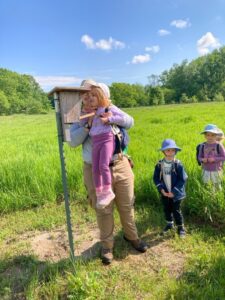
CFS is the explosion of curiosity and enthusiastic learning as children are able to catch a frog and see it up close, watch as bird eggs in a bird box turn to tiny chicks, and watch the seasons change. It is the freedom for our students to be themselves, the space for them to grow and develop in their own time, in their own way. Like the sun or the rain, we tend to what is alive and ready to grow through our practice of emergent curriculum. The learning environment here is ripe, rich, and full of abundant wonder.
Nature, our co-teacher, tells us, “Yes! Yes, you can grow here! Yes, you belong! See the value in a spider’s life and see the value in your own life, too.”
As we wrap up our 2024-2025 school year here at CFS, we reflect on the community that gathers around these students. We are blessed with an unmatched community of children and the families that love, support, and champion them.
We look forward to many of this year’s students and families coming back for the 2025-2026 school year. With the large number of returning students, it will be an opportunity to go deeper with our relationships with the students and learning concepts.
This week, we graduated CFS’s fourth cohort of students who will enter elementary school knowing what it means to “take care of nature.” We’ll be back in the fall with our co-teacher for another year of creating Champions of Nature.